
A man who died at the height of the AIDS crisis in the 1980s was finally laid to rest 39 years later at St. Martin-in-the-Fields Episcopal Church in Keller, Texas.
Between the 1980s and early 1990s, the AIDS crisis claimed tens of thousands of lives across the United States. In 1987 alone, 13,468 people died from AIDS; by 1993, that number had risen to 37,267 deaths in a single year.
The World Health Organization describes those early years of the epidemic as a time of “fear, stigma and ignorance.”With no effective treatment available, many people faced not only a devastating illness, but profound isolation. Too often, there was no one there for them. They were rejected by families, abandoned by friends and pushed to the margins of society at a moment they needed care the most.
Reading Way was living through that reality. But Reading was so much more than AIDS. He loved Mozart, mysteries, spy novels and James Bond most of all. He watched adventure shows, travel programs and musicals. When a piece of music pleased him, he would nod; when it didn’t, he would make a face. He smiled at terrible jokes, and he liked to say Morning Prayer.
At the time, the Rev. Gayland Pool, an Episcopal priest in Fort Worth, was one of the few priests in the city willing to conduct funerals for people who had died of AIDS. Katie Sherrod, a local newspaper columnist who was covering the AIDS crisis both locally and nationally, met Pool through her reporting. He invited her to follow him as he ministered to people living with the disease, which is how she met Reading.
By the time Katie met Reading, he was very ill. Painful mouth and throat ulcers made it difficult for him to speak, so Katie came to know him through smaller things: the music that made him lean in, the things that made him turn away, the books he loved and the jokes that made him smile.
Reading died on December 27, 1987. He had been rejected by his family and died without a place to be laid to rest. For nearly four decades, the people who loved and cared for him carried his remains, hoping that someday he could be reconciled with his family and finally have a place to rest. When the Rev. Gayland Pool died in 2017, Reading’s ashes were still in his care.
Katie, who later became an Episcopalian, eventually found the families of three other men whose ashes the Rev. Gayland Pool had carried, but Reading was the one she could never place. Thirty-nine years after his death, she decided to do the only thing left she could do for her friend: see him home herself.
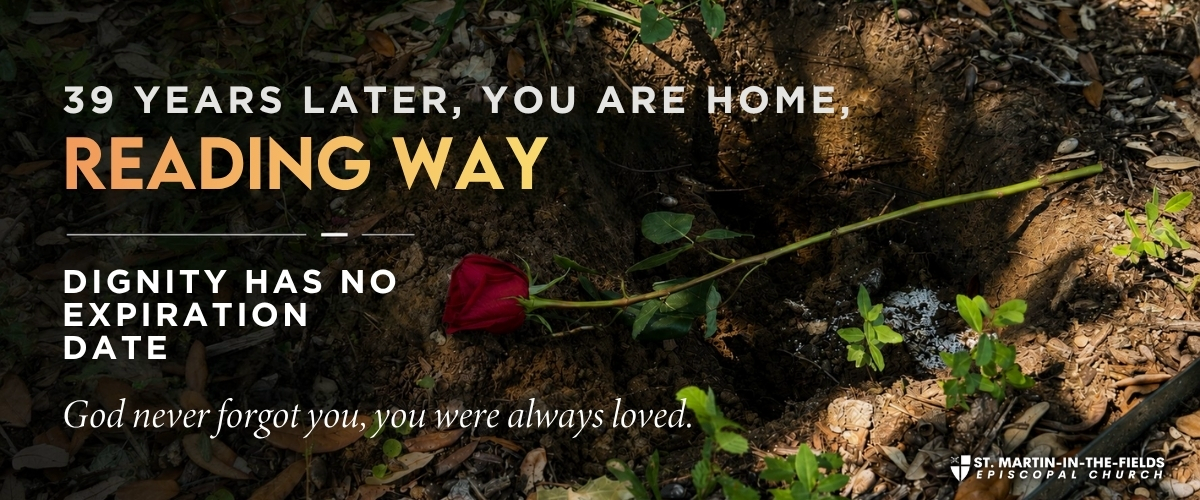
On August 28, 2026, Reading Way was finally laid to rest at St. Martin-in-the-Fields, Keller:
“We are here today to do something that should have been done a long time ago,” Katie said at the funeral, “to lay Reading Way to rest with his name spoken, his life honored, and someone who cared about him standing beside him.”
Thirty-nine years cannot undo the rejection Reading experienced or return the years that were lost. But, as the Rev. Alan Bentrup reflected after his burial, God never forgot him. Neither death, rejection, nor abandonment could separate Reading from the love of God.
Perhaps that is what reconciliation with the past can teach us: not to remain there, but to allow it to change how we see the person standing in front of us today. To listen sooner. To draw closer. To recognize one another while there is still time to say: you matter, you are seen, you are loved.
Reading was never simply one of 13,468. He was a man whose life was worthy of being known beyond the way it ended. And 39 years later, he was laid to rest not as a statistic, not as a diagnosis, but as the person he had always been.
God always loved you. Rest in peace, Reading Way. You are home.
Read Katie Sherrod remarks at Reading Way’s Service
In Memory of Reading Way August 28, 2026
We are here today to do something that should have been done thirty-nine years ago: to lay Reading Way to rest with his name spoken, his life honored, and someone who cared about him standing beside him.
Reading died on December 27, 1987. He was one of 13,468 people who died of AIDS that year in this country — a number so large it starts to sound like weather, like something that just happened, rather than nearly 14,000 individuals who each had a favorite song, a way of laughing, a life that mattered. Reading was not a statistic. He was a man who liked James Bond novels and made a face when he didn’t care for a piece of music.
I was a reporter writing about the AIDs Crisis then, in Fort Worth and nationally. It is hard for us today to remember what that time was like.
